USPA Membership Verification in Your Manifest: Why Manual Lookups Are a Liability Waiting to Happen
TL;DR
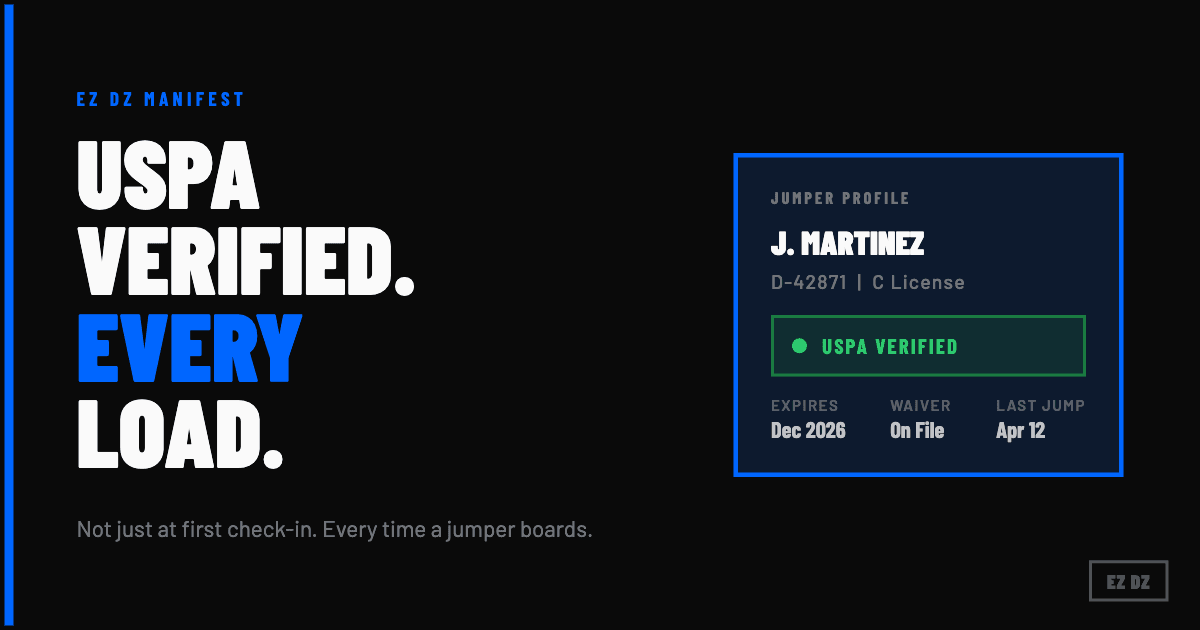
Most dropzones verify a fun jumper's USPA membership once — manually, through the USPA website — and never check again. That single check does not catch lapsed renewals, expired licenses, or memberships that ran out between visits. EZ DZ verifies automatically every time a jumper gets added to a load, surfaces warnings before expiring memberships become a problem, and keeps verification and waiver status in the same system. No separate lookup. No spreadsheet. No gap.
Think about the last fun jumper you manifested. When did you last verify their USPA membership? Not check it — actually verify it against a current record. If the answer is somewhere between "a while ago" and "whenever they first showed up," you are operating in the same way as nearly every other dropzone in the country. And that gap is a real problem.
USPA memberships expire. Licenses lapse. Jumpers who were current six months ago may not be current today. The manual lookup you did at check-in does not update itself. And the spreadsheet or mental note that came after probably did not either. This post is about why that matters, what it exposes you to, and what a manifest system that actually solves the problem looks like.
Why USPA Verification Is a Requirement, Not a Suggestion
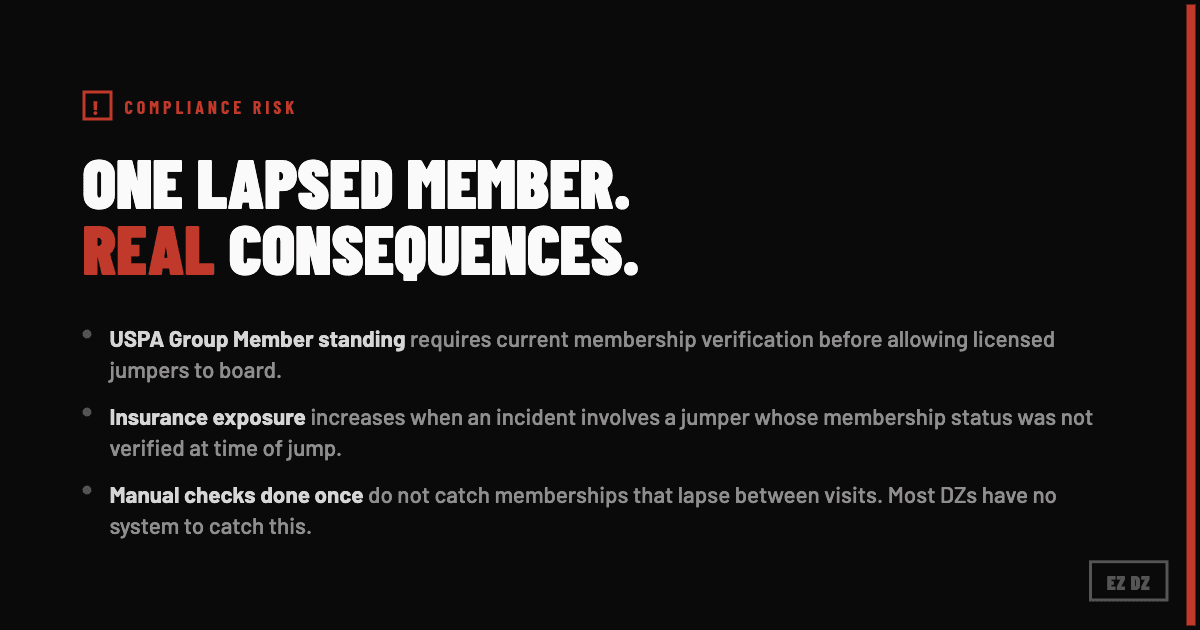
USPA Group Member dropzones are required to ensure that jumpers holding USPA licenses are current members before allowing them to jump. This is not a best practice that some DZOs follow and others skip. It is a condition of your Group Member standing. Your standing affects your insurance, your relationship with USPA, and your ability to host sanctioned events and competitions.
The reason the requirement exists is straightforward: USPA membership includes liability coverage and establishes that a jumper has met the currency and training standards associated with their license level. When a non-current member jumps at your DZ and something goes wrong, the gap in verification is not just a paperwork problem. It becomes a question of whether proper standards were followed and whether your coverage applies.
How Most DZOs Handle It Today
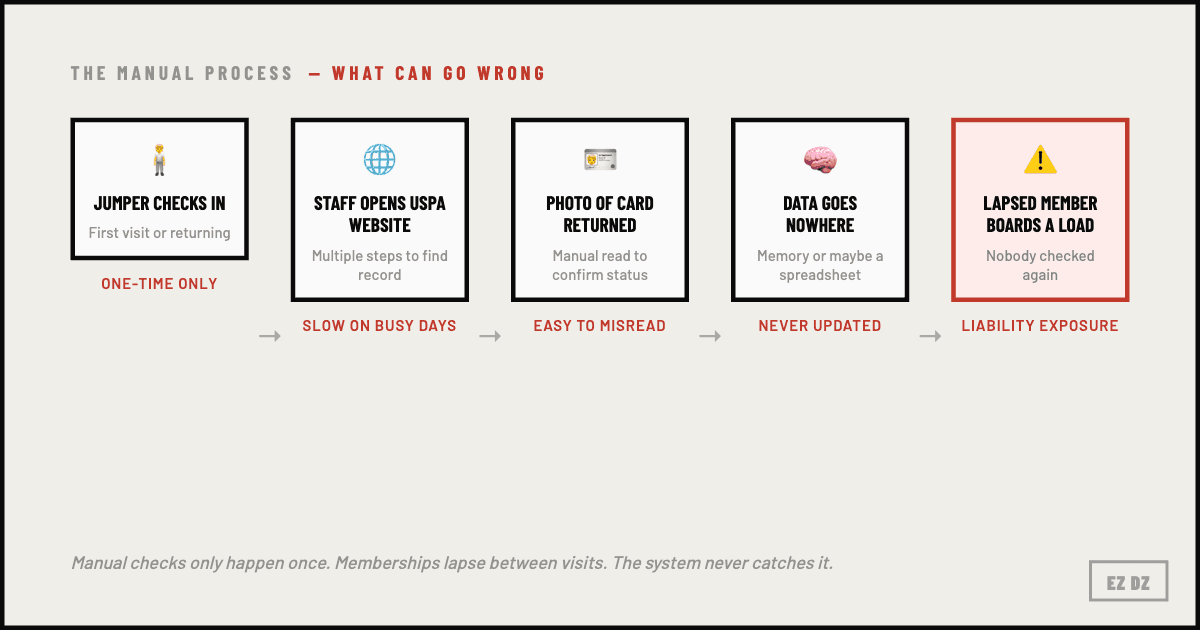
The current process at most dropzones looks something like this. A fun jumper shows up for the first time. Someone at manifest or check-in opens the USPA website, searches by name or license number, and gets back a result — usually a photo of their license card. Staff visually confirm that the card looks current, maybe check the expiration date, and let the jumper through. That verification then lives somewhere between a handwritten note, a spreadsheet row, and the manifest staff member's memory.
The USPA website lookup is not a bad tool, but it was built for individual reference, not operational workflow. The photo-of-card format requires a manual read to extract the relevant information. There are multiple steps between opening the site and confirming a jumper's status. And the result does not flow into your manifest, your load board, or any record that gets checked again automatically. At busy DZs on a Saturday with multiple loads moving, that lookup becomes a bottleneck that gets skipped.
Some DZOs call other dropzones to check currency on jumpers who have been jumping elsewhere. That happens too. And sometimes a DZO knows their regulars well enough to have a feel for who is current. None of these approaches scale. None of them catch the renewal that did not happen.
The Gap Nobody Talks About
Here is the specific problem with a one-time manual check: it only tells you whether a jumper was current on the day you looked them up. USPA memberships are annual. A jumper you verified in March may have let their membership lapse by November. They come back for a jump day in the fall, they check in, your staff recognizes them as a regular, and they board a load. Nobody checks because the verification already happened.
This is not a hypothetical edge case. Jumpers forget to renew. Some renew late. Some are aware their membership lapsed and are hoping nobody notices. The one-time verification model gives a false sense of coverage because the check happened, even if it happened nine months ago when the membership was still valid.
The math on this compounds quickly. If your DZ has 150 active fun jumpers and USPA memberships are annual, statistically some percentage of those memberships are lapsing throughout the year at different points. A manual-lookup-once system has no way to catch which ones without running every name through the USPA site before every jump day. Nobody does that. Which means jumpers with lapsed memberships are boarding loads at nearly every DZ in the country every weekend.
How EZ DZ Handles Verification
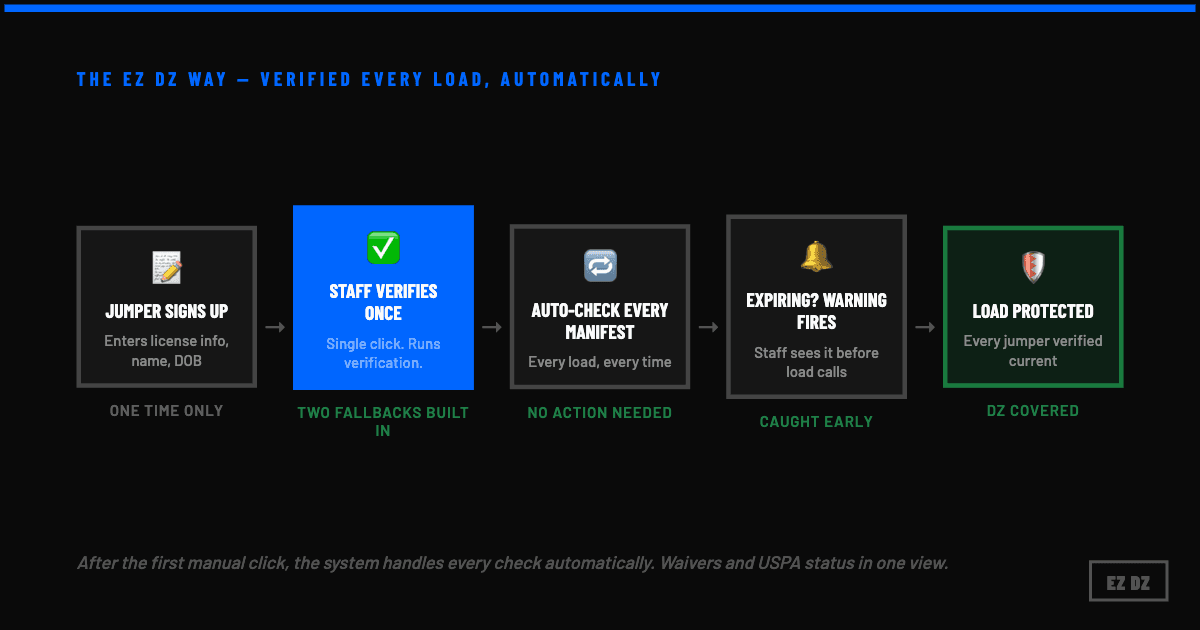
The flow starts when a fun jumper signs up. They enter their license information along with their name, date of birth, and license number. That data lives in their profile. The first time they show up at a dropzone, manifest staff clicks to verify them — a one-time action that runs their information through the verification process.
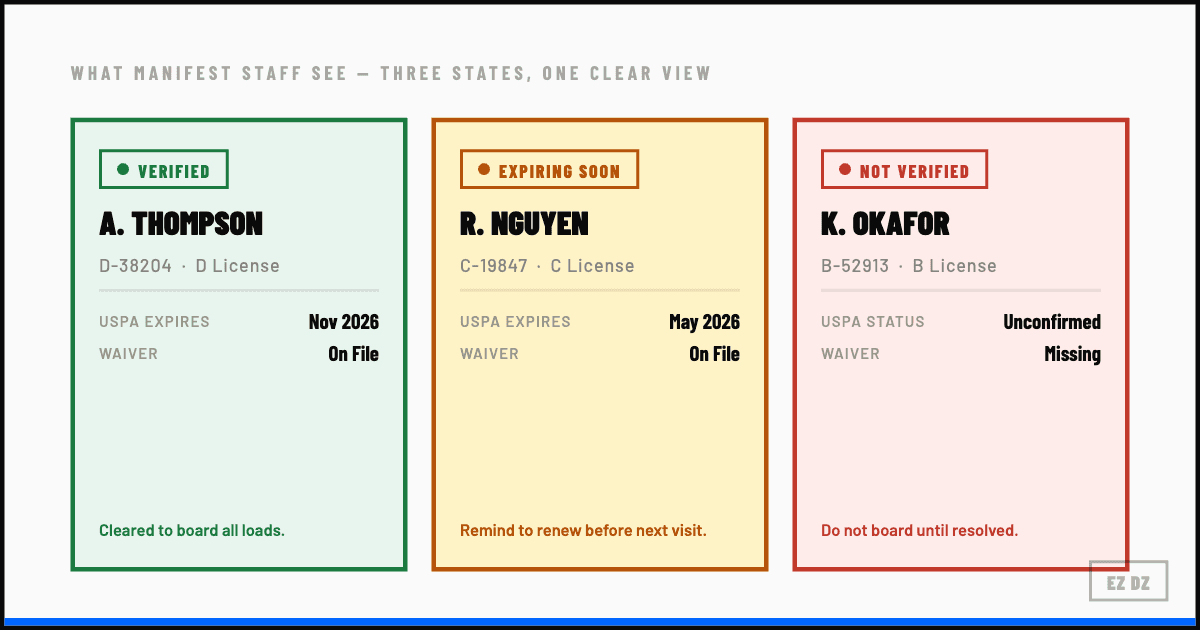
From that point forward, the system takes over. Every time that jumper gets added to a load, EZ DZ runs a verification check automatically. Staff do not have to think about it or initiate anything. If the jumper's membership is approaching expiration, a warning surfaces before they board the load. If they are not current, the system flags it at manifest rather than letting them through unnoticed.
There are two verification fallbacks built in for cases where the primary lookup does not return a clean result — so edge cases like name discrepancies or data entry differences do not create false negatives. There is also a manual search option for staff who need to look up a specific jumper directly. The goal is to make the right path the easy path, and the system is built around that.
Waivers and Verification in the Same System
One of the friction points in the manual verification world is that verification and waiver status live in different places. You might check USPA membership on the website, then check a separate waiver system or paper log to confirm they have signed. Two lookups. Two systems. Two places where something can slip through.
EZ DZ keeps both in the same place. A jumper's USPA verification status and their waiver completion status are both visible in their profile and surface together at manifest. Before someone boards a load, staff can see in one view whether they are USPA current and whether they have a valid waiver on file. No separate lookup, no toggling between systems, no relying on memory for which check was done and which was not.
The jumper verification feature covers both USPA status and waiver tracking in one place, so your manifest staff always has a complete compliance picture before a load calls.
The Liability You Can Actually Avoid
I spent time in real estate before building EZ DZ, and one thing that transferred directly was an understanding of how liability works in practice. In real estate, errors and omissions insurance exists because even well-intentioned professionals make procedural mistakes. The coverage only holds when you can demonstrate that standard procedures were followed. When you cannot, the exposure is yours.
The same logic applies at your dropzone. If an incident occurs involving a jumper whose USPA membership had lapsed and your verification process was a manual lookup from nine months ago, the question becomes whether a reasonable standard of care was followed. A system that checks automatically every time someone boards a load is a much stronger answer to that question than a spreadsheet or a memory.
This is not about assuming the worst or building your operations around fear of incidents. Most days, none of this surfaces as a problem. But the jumpers with lapsed memberships are out there every weekend at every DZ, and the DZOs who have a system that catches them are in a fundamentally different position than the ones who do not. The system is not expensive to run. The gaps in the manual process are.
Verification that only happens once is not verification — it is a record that something was checked at a point in time. A manifest system that checks every load treats USPA currency as the ongoing condition it actually is, not a box that gets checked at first visit and forgotten.
When I built the verification system into EZ DZ, the goal was to make it impossible to accidentally skip. Manifest staff should not have to remember to check. They should not have to open a second browser tab. The check should happen as part of the manifest flow, surface what it needs to surface, and stay out of the way when everything is current. That is the version of compliance tooling that actually gets used.
See how verification works inside the manifest
EZ DZ keeps USPA verification, waiver status, and manifest management in one place. Get started and have your fun jumper compliance automated before the season gets busy, or reach out if you want to walk through how it fits into your current check-in workflow.