How to Fill Last-Minute Open Slots at Your Dropzone Without Blowing Up Manifest
TL;DR
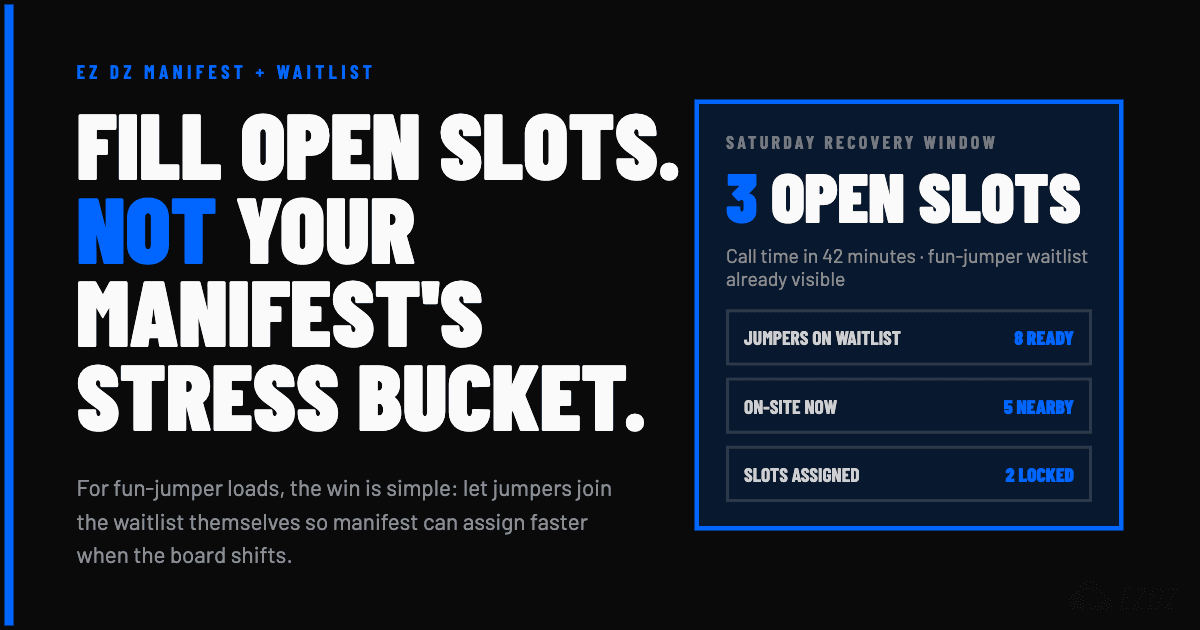
Most dropzones do not have a demand problem when fun-jumper loads leave with empty slots. They have a coordination problem. A real waitlist lets jumpers put themselves in line so manifest can allocate open slots faster, and the surrounding automation matters too: reminders help people show up on time, waiver nudges help them arrive ready, and compliance visibility helps staff avoid last-minute surprises. EZ DZ was built to make that workflow cleaner without turning manifest into a texting desk.
Here is a question I keep coming back to: when a Saturday load leaves with two or three empty fun-jumper slots, is that really a demand problem, or is it just an operations problem wearing a demand costume?
Most DZOs I talk to already have people who would have taken those slots. The issue is that demand lives in text threads, verbal maybe's, a mental shortlist in someone's head, or a waitlist nobody trusts enough to use quickly. By the time manifest starts working the problem, call time is too close, the staff is already buried, and the easiest decision is to let the plane go light.
I learned a version of this in real estate. People think lead generation is the hard part. Sometimes it is. But a shocking amount of lost revenue comes from already-existing demand that never gets handled in a structured way. The same thing happens at dropzones. Empty seats are often just unclaimed demand.
Empty slots are more expensive than they look
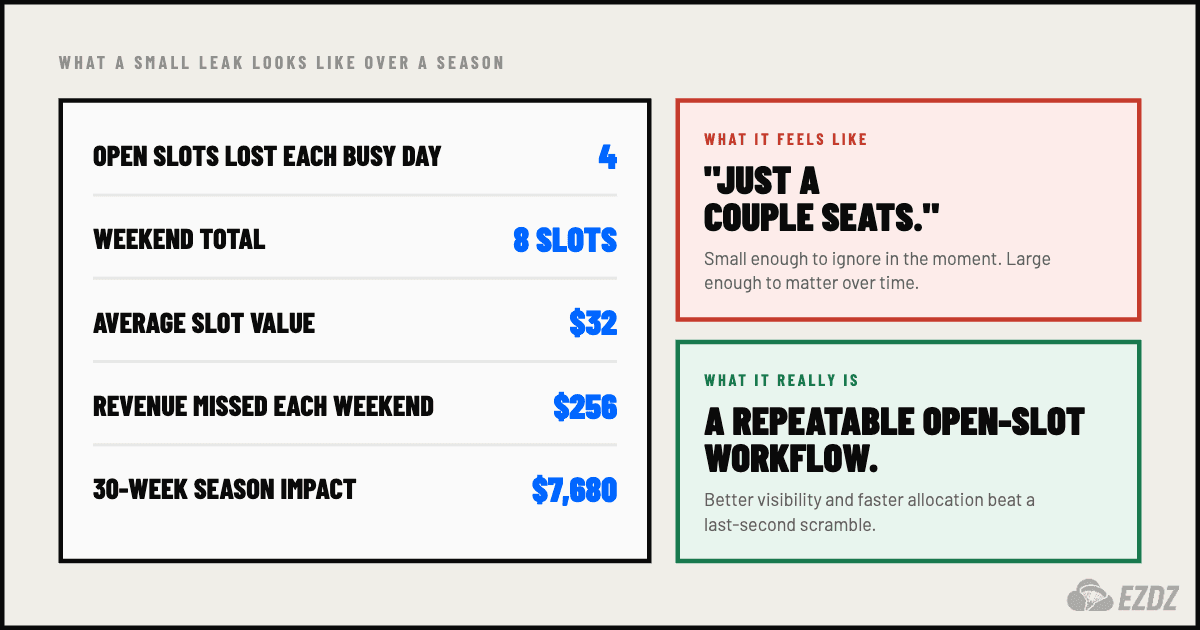
Let us do some simple math with conservative numbers. Say your average fun-jumper slot is worth $32 after ticketing and typical lift pricing. If you lose just 4 slots each busy day across Saturday and Sunday, that is 8 empty slots for the weekend, or $256 in top-line revenue gone. Stretch that across a 30-week season and you are looking at $7,680.
That still undersells the problem because the true cost is not just the seat. Empty slots also distort aircraft efficiency, make staffing feel more expensive than it should, and hide the fact that your demand-response system is leaking. If you lose 10 to 12 seats on bigger weekends, which is not hard to do when weather, no-shows, or late check-ins create gaps, the season number gets real fast.
Want the shortcut? Stop treating open slots like an in-the-moment scramble. Treat them like a recurring manifest workflow with clear waitlist rules, clean assignment steps, and fewer day-of surprises.
Why the usual fixes fail
The knee-jerk answer is usually some mix of: make a PA announcement, text a few regulars, toss something in the group chat, or ask manifest to work through a paper list. The problem is not that those tactics never work. The problem is that they only work when the right staff member has enough time, the right jumper hears about it fast enough, and nobody double-promises the same slot. That is not a system. That is luck with extra steps.
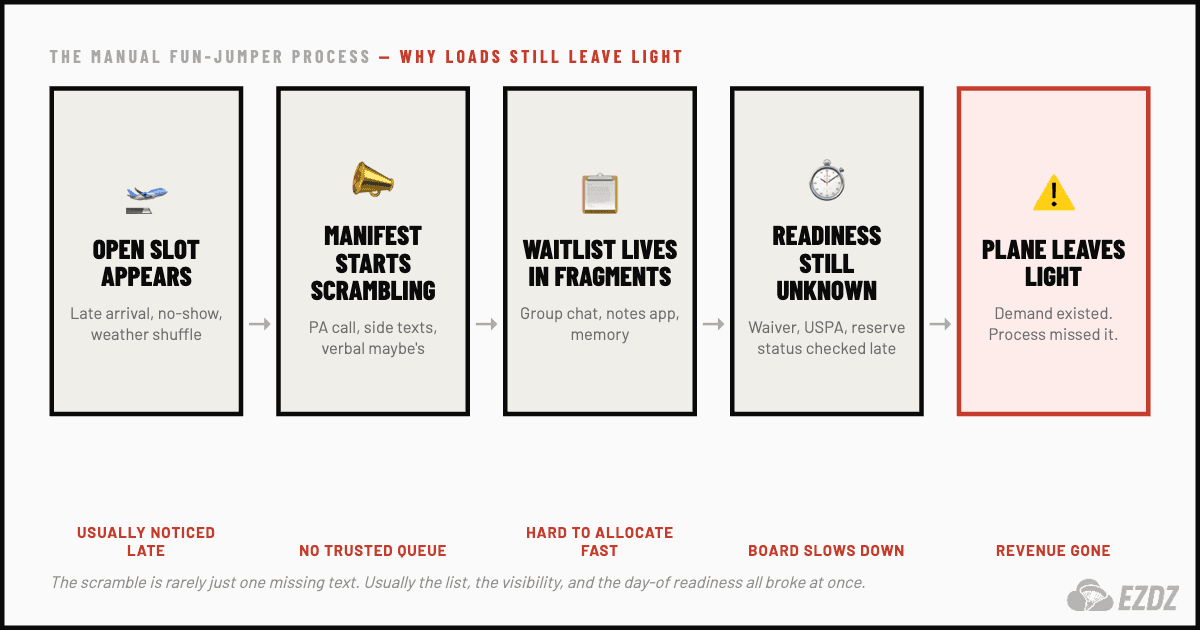
- **The list is weak:** Jumpers were never given a simple self-serve place to raise their hand for the right kind of slot.
- **The timing is late:** Manifest is trying to solve an urgent problem instead of using a list that was already there.
- **The board is missing context:** Waiver status, USPA checks, reserve status, or basic readiness still have to be figured out at the worst possible moment.
- **Nobody learns from it:** You do not know which slot types go unfilled most often or whether the bottleneck is demand, timing, or front-desk friction.
I spent time in a moving-box business that did real volume, and the lesson there was brutally simple: the business that wins is usually the one that removes friction from the boring middle. Open-slot recovery lives in that boring middle. It is not glamorous. It just makes money when you do it well.
The slot recovery system that actually works
The fix is not to yell louder. It is to build a simple four-part system that gives manifest leverage before the load becomes urgent.
1. Let fun jumpers put themselves on a real waitlist
For this use case, the waitlist is not really a follow-up engine. It is a clean self-serve queue. Fun jumpers should be able to raise their hand for open-slot opportunities so manifest is not rebuilding demand from scratch every time the board shifts. The more that list lives in the software instead of in somebody's head, the more useful it becomes.
2. Make manifest visibility do the heavy lifting
Once that list exists, the real win is allocation speed. Manifest should be able to see open slots, see who is waiting, and assign intelligently without a bunch of side-channel communication. That is where the gap gets closed: not in a heroic follow-up sequence, but in cleaner live operations.
3. Remove the day-of friction around the load
This is the part people underrate. Marketing automation is not just for abandoned carts. The same reminder stack that helps tandems show up on time can also reduce load friction: waiver reminders before arrival, better pre-arrival communication, and cleaner customer records mean staff spends less time untangling basics when the board is moving. The broader ops layer matters here too. If USPA status, reserve currency or repack visibility, and waiver completion all live in one place, manifest can make faster decisions with fewer last-minute surprises.
Notice the leverage here. A waitlist helps fill open fun-jumper slots. Reminder automation, waiver completion, and compliance checks help the whole day run cleaner. They work together, but they are not the same feature.
4. Keep assignment clean and visible
The fastest recovery systems do not leave manifest guessing. Once a slot is assigned, the board should reflect it immediately and the next staff member should not need a verbal handoff to understand what happened. Clean visibility beats frantic communication almost every time.
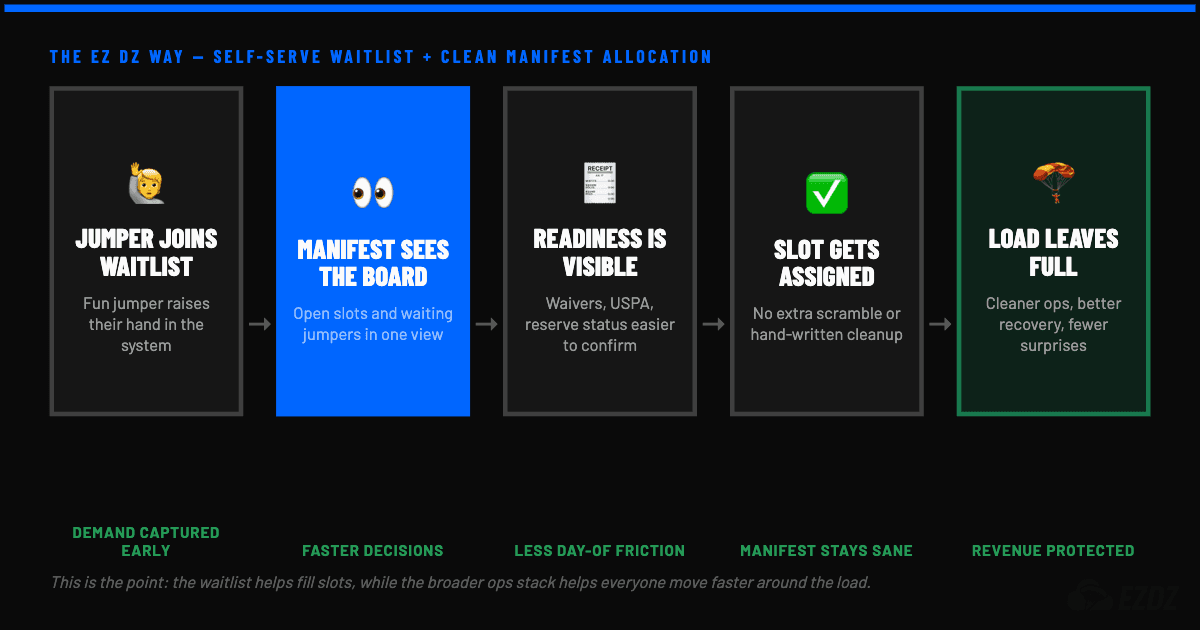
Learn more about EZ DZ manifest workflows to see how live load visibility, waiver status, and mobile-first assignments reduce the scramble around open slots.
What the math looks like on a normal weekend
Let us use a more grounded operator example. Say you run 14 fun-jumper loads over a busy weekend and average 1.5 open slots per load that could realistically have been filled with better visibility and faster allocation. That is 21 seats. At $32 each, that is $672 in missed revenue. Recover just one-third of those and you pick up $224 for the weekend. Over a 30-week season, that is $6,720. Recover half and you are at $10,080.
That is why I like this topic. It is not fantasy math. It does not require a massive marketing campaign. It is just operational recovery. And the nice part is that it compounds with the rest of your stack: better booking data, better manifest visibility, faster waivers, better reminders, and cleaner compliance checks all make the same weekend run tighter over time.
There is also an important distinction here. The waitlist math above is intentionally based on fun-jumper slot value, because that is the workflow this feature directly improves. But in many operations, the bigger revenue-protection upside comes from tandem-side automation around no-shows, late arrivals, reminders, and pre-arrival waiver completion. That is a separate lever from the waitlist itself, and in dollar terms it can be materially larger.
- **Track the leak first:** Count open fun-jumper slots by daypart, aircraft type, and cause for two or three weekends.
- **Make the waitlist self-serve:** Do not rely on staff memory as the source of demand.
- **Audit your day-of friction:** Measure how often waivers, late arrivals, or compliance checks slow down slot assignment.
- **Measure fill rate:** If open slots consistently exist while willing jumpers exist too, the gap is operational and fixable.
Want to see where your operation is leaking? Good analytics should show open-slot patterns, waitlist usage, waiver completion timing, and where load-day friction keeps stealing speed from manifest. If your current system cannot tell you that, you are flying partially blind.
Where to start this week
If you are not ready to automate anything yet, start with a manual version that is at least structured. Give fun jumpers one real place to join a waitlist. Define exactly how manifest sees and works that list. Then look one layer upstream: are people arriving on time, are waivers done before they hit the desk, and are your compliance checks visible before the load gets tight? That alone will outperform the usual chaos.
If you are ready to modernize it properly, this is exactly the kind of workflow EZ DZ should own. A real waitlist helps fill open slots. Better reminders and waiver automation help people show up ready. USPA and reserve-status visibility help staff move faster with more confidence. Put together, those systems reduce the Saturday scramble without pretending one feature does everything by itself.
Ready to recover more open slots without creating more manifest chaos?
The best dropzones are not magically immune to last-minute gaps. They just have cleaner systems for capturing demand, seeing readiness earlier, and assigning faster when the board shifts.
Get started and see how EZ DZ brings waitlists, manifest visibility, waivers, and communication into one workflow, or reach out if you want to talk through how your DZ currently handles open slots. Even if you do not use our system, fix this. It is one of those small operational leaks that compounds all season.