Skydiving Near Me: How to Win the Local SEO Game Before a Single Ad Dollar Spent
TL;DR
- Google's Map Pack is where most first-time tandem customers make their decision — and it's dominated by review volume, not star rating
- The #1 ranked dropzone in most markets has more reviews than anyone else — even with a slightly lower rating
- Most dropzones lose the review race because they rely on humans to ask at the wrong moment
- Three things separate first place from second: review count, post activity, and linked profiles — in that order
- The fix is a timing problem, not a hustle problem
Right now, someone in your area just typed that. Did they find you?
That three-word search — 'skydiving near me' — is the moment most first-time tandem customers make their decision. They're not going to your website first. They're not scrolling through ads. They pull up Google, see a map with three results, glance at the ratings and review counts, and pick one. The whole process takes about 8 seconds.
If you're not in those top three results, you're invisible — and you'll never know the booking you didn't get. That's the part that bothers me most about this problem. It's completely silent. No empty time slot on the manifest, no cancellation notification. Just a customer who chose someone else before they ever saw your name.
The good news is this ranking isn't mysterious. It's not about who spends the most on ads or who has the most polished website. It's driven by something specific and buildable. Let me show you what's actually going on.
The Map Pack Is Where You Win or Lose
When someone searches 'skydiving near me,' Google returns what's called the Local 3-Pack — a map with three businesses listed below it. Studies consistently show that the top three results capture 70-80% of all clicks. If you're in position four or lower, you're fighting over scraps. If you're not on the first page at all, you essentially don't exist for that search.
The factors that drive Local 3-Pack rankings come down to three things: proximity (how close you are to the searcher), relevance (does your profile match what they're looking for), and prominence (how well-known and trusted Google thinks you are). You can't change your location. You can make sure your profile is complete. But prominence — that's the lever. And the single biggest driver of prominence for a local business is review volume.
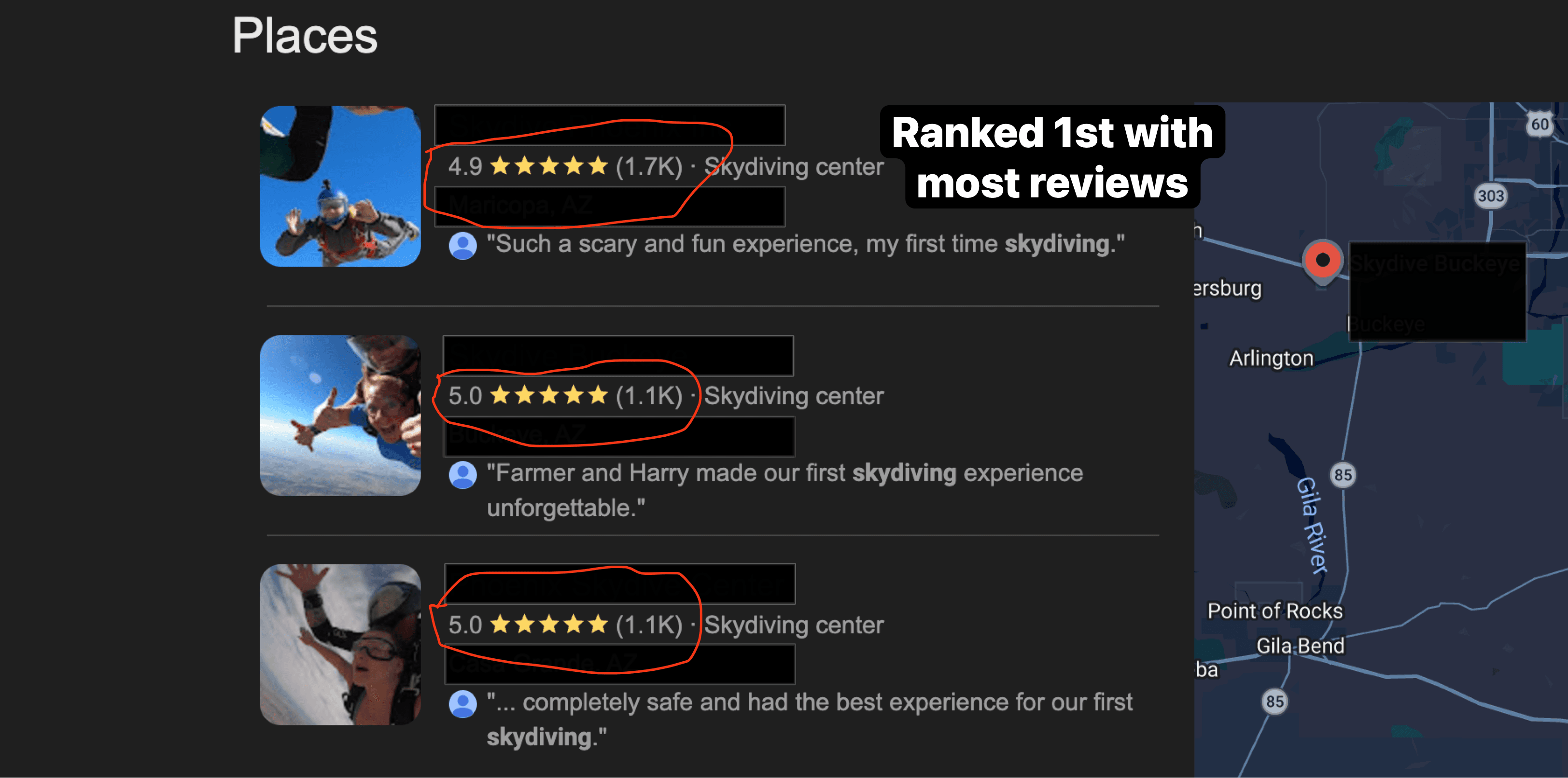
Look at this closely. The top-ranked dropzone doesn't have the best rating. They have the most reviews. That's not a coincidence — that's the algorithm working exactly as designed. Google doesn't just trust star averages. It trusts businesses with sustained, ongoing social proof. A thousand people saying you're great over three years is worth more than fifty people saying you're perfect last month.
This distinction matters for how you think about the problem. Chasing a 5.0 average is the wrong goal. Building compounding review volume is the right one.
What #1 Looks Like vs. #2
I pulled the Google Business Profiles for the top two ranked dropzones in this market and looked at what actually separates them. The difference isn't dramatic — it's three things, and one of them is far more important than the other two.
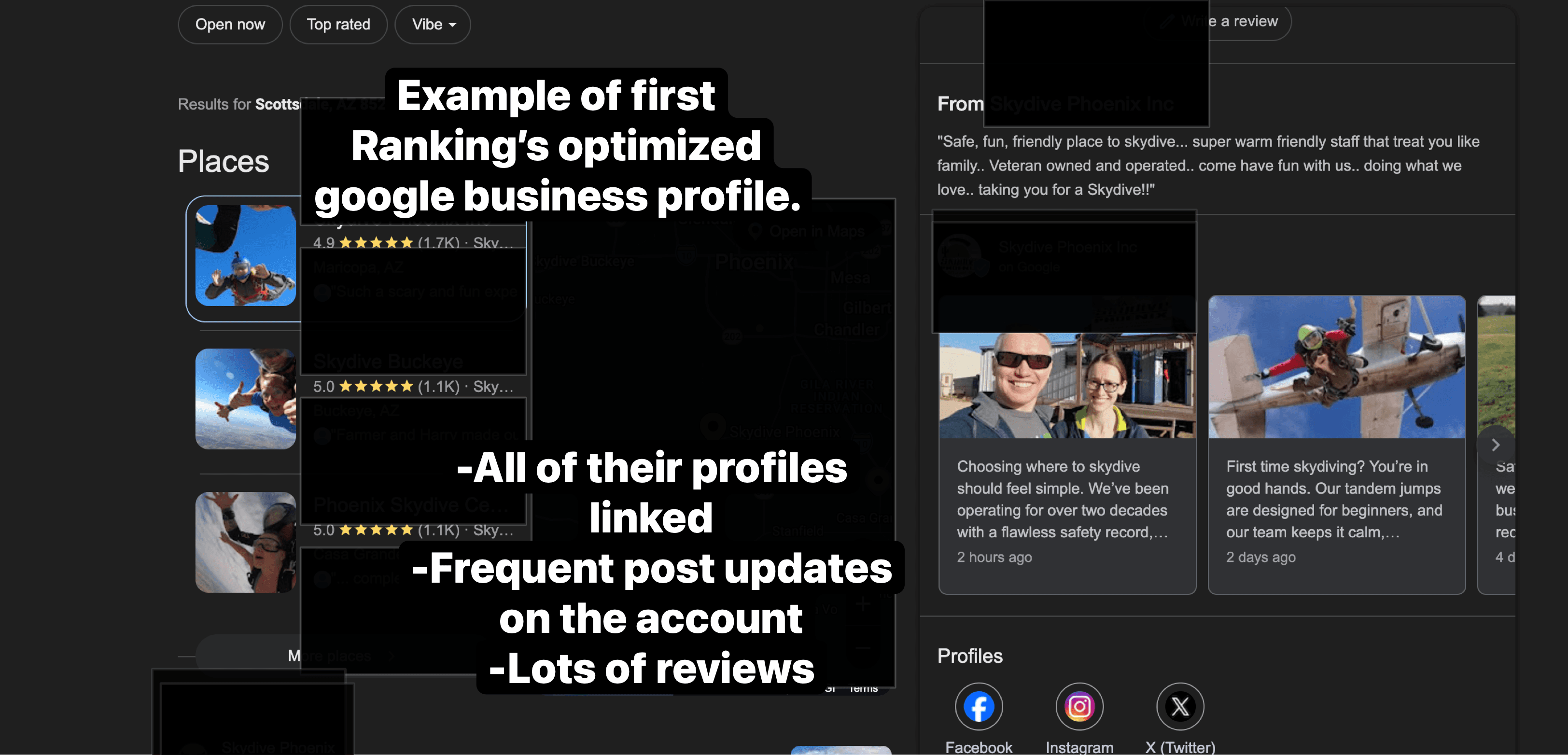
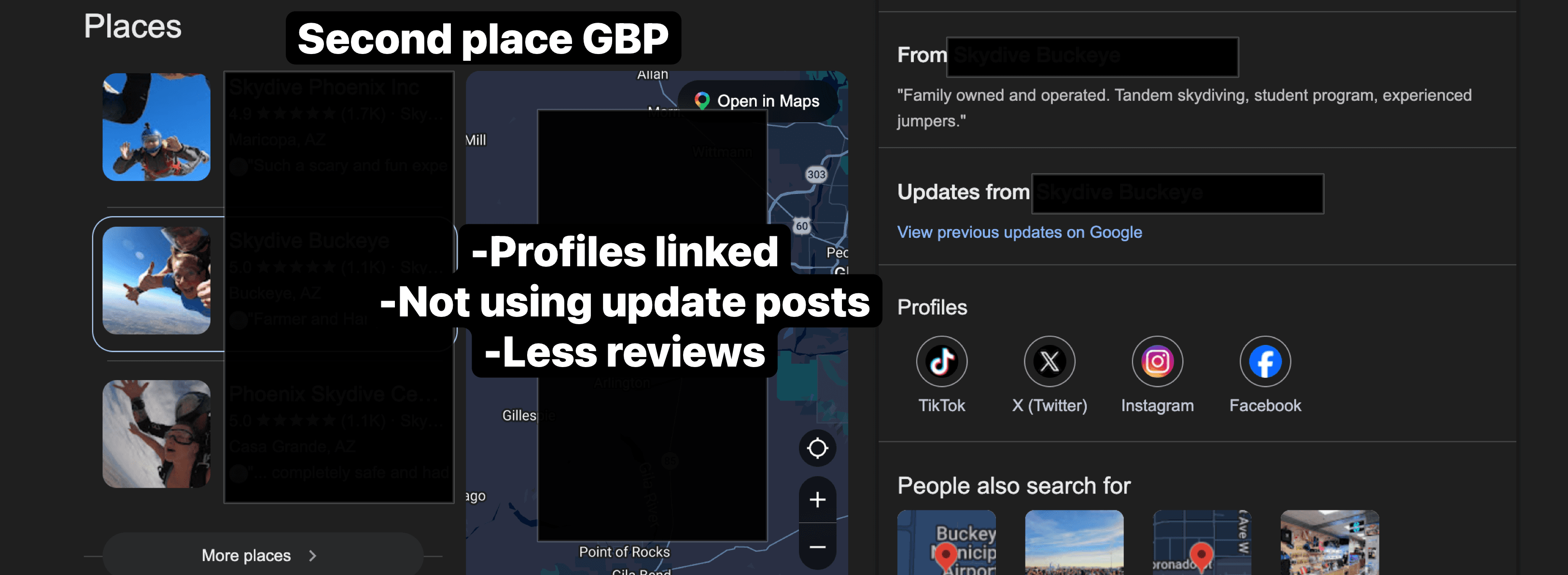
The three differences, in order of impact:
- **Review count** — the largest gap by far. More reviews, more consistently earned, over a longer period. This is the primary ranking driver.
- **Post activity** — #1 posts regularly. Photos, updates, jump day highlights. #2 has the profile set up but isn't using the posting feature. Google treats an active profile differently than a dormant one.
- **Linked profiles** — both have their social accounts connected. This is table stakes at this point. If you haven't done it, do it today — it takes ten minutes.
The profile completeness gap is small. The posting gap is meaningful but fixable fast. The review gap is where the real work happens — and where the real leverage is. If you close the review count gap, you climb the ranking. It's that direct.
Why Your Review Count Is Stuck
Most dropzones I talk to know reviews matter. They've got a sticker on the exit door. Their TIs mention it at landing. Maybe they send an email a few days later. And yet their review count barely moves.
Here's why: none of those methods hit the customer at the right moment. And timing is almost everything.
Think about the emotional arc of a tandem customer. Before the jump: anxiety, second-guessing, nervous energy. During freefall: pure adrenaline, no coherent thoughts. Right after landing: relief, euphoria, disbelief. Then about 45 minutes to an hour later, they're in their car or at a nearby restaurant, still buzzing, phone in hand, texting everyone they know about what they just did. That's the window.
An hour after landing is when a customer is most likely to see your message, most likely to remember the experience vividly, and most emotionally motivated to share it. They want to tell people. A review request at that moment isn't an ask — it's an outlet.
Contrast that with the methods most dropzones rely on. The sticker on the exit gate competes with a dozen other stimuli. The verbal ask from a TI who just finished a full day of jumps is easy to forget — the customer is still processing what just happened. The email three days later lands when they're back at work, the feeling is largely gone, and leaving a review feels like effort rather than joy.
The math on this is significant. Dropzones relying on verbal asks and delayed emails typically convert 8-12% of customers into reviewers. Automated requests sent at the right post-jump window consistently hit 30-40%. On a 60-jump Saturday, that's the difference between 6 new reviews and 21 new reviews — every single weekend.
This isn't a motivation problem or a customer loyalty problem. It's a timing problem. The customers want to leave reviews. You're just not reaching them when they're ready to write one.
The System That Actually Builds Review Volume
I learned this principle in real estate before I ever built EZ DZ. Speed-to-lead is everything — not because being fast is impressive, but because timing determines whether you reach someone in the right mental state to act. A follow-up call to a real estate lead at 5 minutes is 100x more likely to convert than the same call at 60 minutes. The information is identical. The timing is everything.
The same principle applies here. Here's the four-part system:
- **Send the request at T+45min to T+90min post-jump.** Not the next morning. Not the next day. Not a week later. The emotional window is real and it closes fast. If you hit it, conversion is high. If you miss it, you're chasing someone who has moved on.
- **Make it one tap.** Your review request needs to include a direct link that opens their Google review form immediately — no searching for your business, no navigating menus. Every extra step cuts conversion in half. The link should go directly to your Google Business Profile review page.
- **One follow-up, then stop.** If they didn't leave a review within 24 hours, send one gentle follow-up. Then let it go. Pestering a customer who isn't going to review you won't change their mind — it'll just annoy them.
- **Respond to every review within 48 hours.** Positive ones and negative ones. Google factors response activity into profile prominence. And potential customers read your responses to bad reviews more carefully than any 5-star comment — a well-handled 2-star says more about your culture than fifty generic glowing reviews.
The compounding math here is what makes this worth caring about. A 60-jump Saturday with a 35% review capture rate is 21 new reviews. Twenty weekends in a season is 420 reviews. Do that for two seasons and you have 800+ reviews and a Map Pack position that's essentially untouchable in most markets.
Compare that to the industry average of 60-80 reviews per season from verbal asks and delayed emails. After two seasons you have maybe 150 reviews. Your competitor who figured out timing has 840. That's not a gap you close with a weekend push — that's a structural disadvantage that compounds every year you're not running the right system.
Your review follow-up shouldn't depend on someone remembering to ask.
EZ DZ automatically sends a review request to every customer at exactly the right post-jump window — no manual sending, no relying on your manifest team to remember, no inconsistency across busy days and slow days. The timing is built in so you never miss the window.
Get started with EZ DZ or reach out if you want to talk through how it works first. Either way, the principle stands — fix the timing and your review count will follow.
The Other Two Factors (Don't Skip These)
Reviews are the main lever. But while you're building that system, don't leave easy points on the table.
**Link your social profiles.** Go into your Google Business Profile right now and make sure your Instagram, Facebook, TikTok, and any other active social accounts are connected. It takes ten minutes. Google uses linked profiles as a signal of profile completeness and business legitimacy. Both the #1 and #2 dropzones in the example above had this done — it's table stakes.
**Post regularly on your GBP.** This is the part most dropzone owners don't know about. Google Business Profile has a posting feature — similar to a social feed — and Google rewards profiles that use it. You don't need to post daily. Once or twice a week is enough. Jump day photos, weather updates, seasonal announcements, or even a quick 'We're jumping today, book before noon' post. The #1 ranked dropzone in the market we looked at does this consistently. The second place one doesn't. That difference is visible in the ranking.
**Respond to every review.** I mentioned this in the system section, but it deserves its own moment. Response rate and response recency are both factors Google weighs. More importantly: potential customers read your responses to negative reviews carefully. A thoughtful, empathetic response to a 2-star complaint that shows you take the experience seriously will convert more fence-sitters than ten more 5-stars from happy customers who all said roughly the same thing.
What to Do This Week
None of this requires a marketing budget. Here's what you can act on in the next seven days:
- **Pull up your GBP and count your reviews.** Then search 'skydiving near me' from your area and count your top competitor's reviews. That gap is your benchmark.
- **Link every social profile you have.** Log into your Google Business Profile, go to the social links section, and connect everything active.
- **Set up a posting schedule.** Even once a week. Commit to it. Put it on the calendar.
- **Fix your review timing.** Whether you use EZ DZ's automated request or set a phone reminder for every load — get a system in place that hits customers at T+45min to T+90min after landing. Not days later.
- **Start responding to reviews you've been ignoring.** Go back through the last month. Respond to everything, positive and negative. Then keep up with it going forward.
The dropzones that dominate local search aren't doing anything exotic. They're doing the basics consistently, at scale, without relying on humans to remember. That's the whole game. Build the system, run it every jump day, and let the math compound over a season or two. The Map Pack position follows.
Every organic review you earn is a lead you didn't have to pay for — and it keeps working long after the season ends. That's the most durable marketing asset you can build.