Best Dropzone/Skydive Operation Management Software for 2026
TL;DR
- #1 EZDZ: All-in-one platform with transparent pricing, mobile-first design, built-in cart recovery, and optional fee pass-through that can make the platform cost-neutral. Best for dropzones wanting modern tech without module fees.
- #2 Burble: Industry incumbent with deep feature set but module-based pricing, legacy UI, and desktop-focused workflows. Best for large operations already invested in their ecosystem.
- #3 FareHarbor/General Booking: Flexible booking platforms that work for many industries but lack skydiving-specific features like manifest, gear tracking, and licensing verification. Best for tandem-only dropzones with separate manifest solutions.
- The real cost isn't subscription fees—it's abandoned bookings, no-shows, training time, and hidden module add-ons you don't discover until you need them.
- Your software choice should align with your growth strategy: Do you want a partner that profits when you grow, or one that profits from keeping you locked in?
Choosing the right drop zone management software in 2026 isn't about which platform has the longest feature list—it's about revenue capture, operational efficiency, and whether you're paying module fees or actually growing your business. After testing dozens of dropzone booking flows and building EZ DZ from the ground up, I've seen what works and what doesn't.
Here's my honest ranking of the three main options for dropzone operators, based on real-world performance, total cost of ownership, and what actually matters for running a profitable operation in 2026.
Table of Contents
- #1: EZDZ - Modern, All-in-One, Aligned Incentives
- #2: Burble - The Established Player
- #3: FareHarbor & General Booking Platforms
- Why Your Software Choice Matters More Than You Think
- What Makes Great Dropzone Software in 2026
- The Real Cost Analysis (Beyond Subscription Fees)
- Making the Switch: What Actually Matters
- Which Platform is Right for Your Dropzone?
🥇 #1: EZDZ - Modern, All-in-One, Aligned Incentives
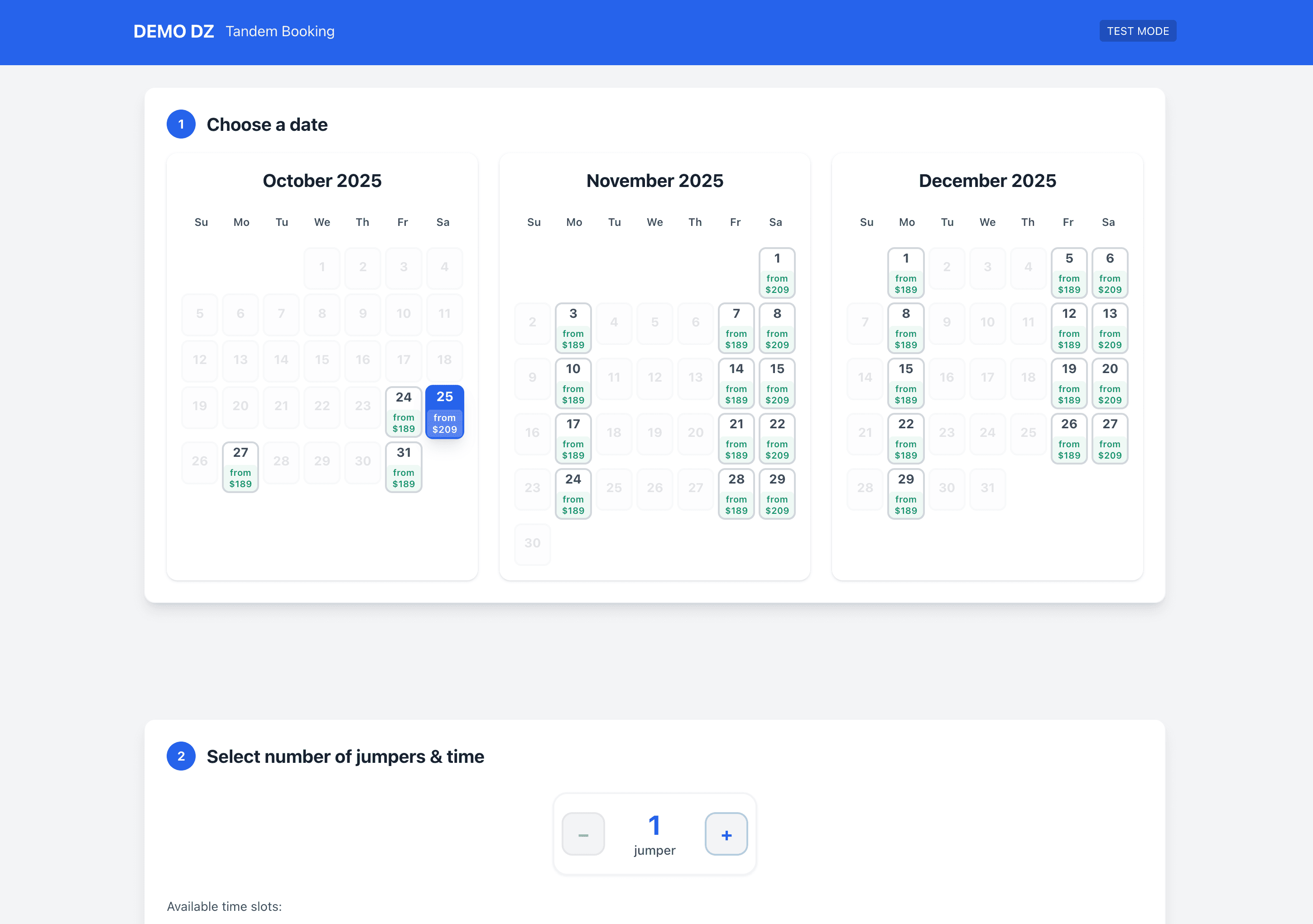
I'm obviously biased since I built this, but let me show you exactly why EZ DZ exists and what problems it actually solves. When I was researching dropzone problems while building the platform, I kept seeing the same issues: clunky booking experiences losing customers, no cart recovery, staff tied to desk computers, and death by a thousand module fees.
EZ DZ was built around a simple principle: we only succeed when you grow. No module fees, no vendor lock-in, and an optional fee pass-through that can make the platform operate at zero net cost if you choose to pass fees to customers (just like concert tickets, vacation rentals, and nearly every other industry).
Revenue Recovery Built-In
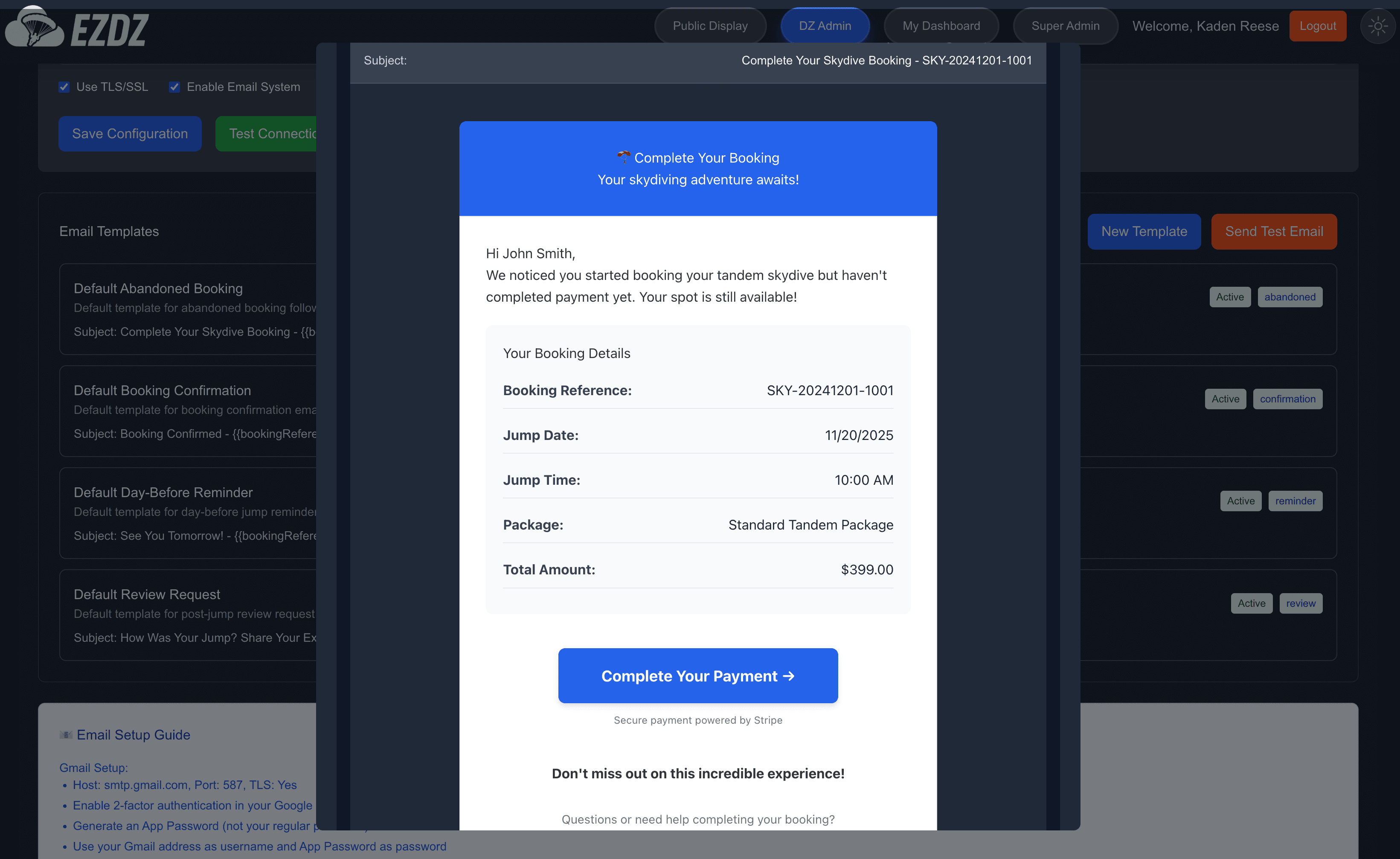
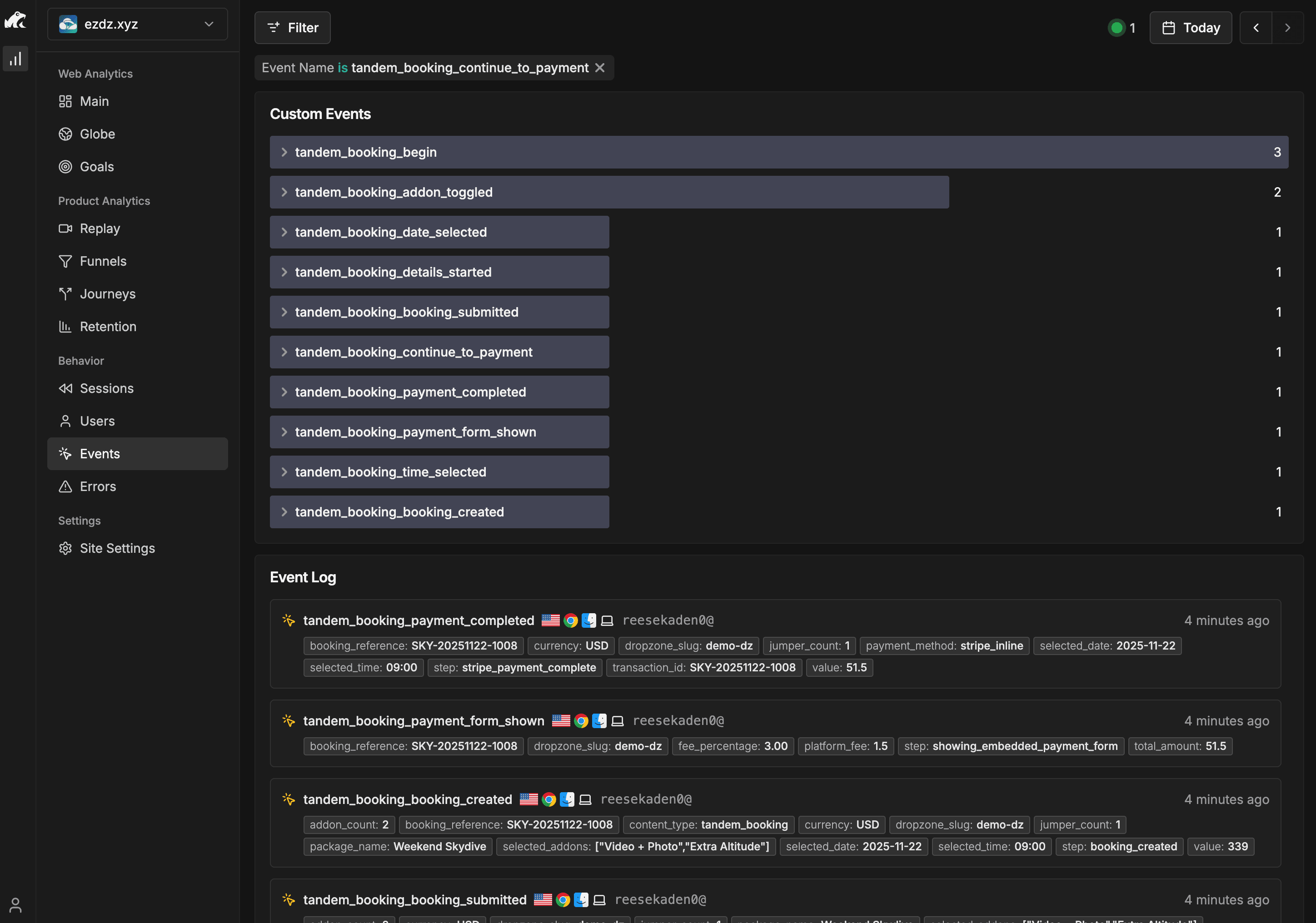
When we built EZ DZ, event tracking was one of the first systems I insisted on getting right. Every meaningful action on the booking page fires a tracked event, so we know exactly when someone abandons. Thirty minutes later, they get a friendly reminder email with a one-click link to complete their booking.
Why 30 minutes and not 5 or 2 hours? At 5 minutes, they're likely still dealing with whatever caused the interruption—your email feels pushy. At 2 hours, they've mentally moved on. Thirty minutes is the sweet spot where they've resolved the interruption but haven't context-switched away.
The real math: Based on industry benchmarks, 12-15% recovery rate on abandoned bookings could translate to an estimated $25,000-$40,000 per season for a typical dropzone. Day-before reminder emails can reduce no-shows by 15-25%, potentially adding another $20,000+ in saved revenue. These estimates are based on typical dropzone metrics and actual results vary.
This isn't just theoretical. In their first 30 days on EZ DZ, Skydive South Texas recovered $4,501 in abandoned bookings automatically—12 of 37 nudged customers came back and completed checkout, a 32% recovery rate, with zero staff effort. Their add-on attach rate also climbed from 60% to 82.2%, and automation saved their team an estimated 63 hours of manual follow-up work.
Mobile-First Everything
Your manifest team shouldn't be running back and forth to an office computer. They should be building loads from the hangar floor. Jumpers shouldn't wait in line to check in—they should check themselves in from the parking lot. Updates should sync in real-time across every device automatically, not require manual refreshes.
This isn't about having a mobile app as an afterthought. It's about the entire platform being built mobile-first because that's how operations actually work in 2026.
Fee Pass-Through Option (The Game-Changer)
Here's what makes EZ DZ different: you can choose to pass platform fees to customers at checkout. Just like buying concert tickets, booking a vacation rental, or any other online purchase in 2026, customers can cover the small platform fee as part of their booking.
What does this mean in practice? On the Starter plan with fee pass-through enabled, your out-of-pocket platform cost can be zero—you'll still pay standard card processing fees (around 2.9% + 30¢) like all platforms, but no additional platform fees. On the Pro plan, it gets even better: you only pay 2% transaction fees, but you can still pass through 4% to customers—giving you a 2% spread that helps offset standard payment processing costs. Want to fully cover processing too? You can request to pass through 5% instead, keeping almost your full booking value—all features included with optional fee pass-through. You control whether to absorb fees to keep your advertised price simple, or pass them through.
This isn't hidden or sneaky—it's transparently labeled at checkout and you have full control over how it's presented. But it fundamentally changes the economics: instead of platform costs eating into your margins, they can be covered by customers who expect to pay booking fees in 2026.
Conversion-Optimized Booking
The booking flow supports Apple Pay, Google Pay, and saves progress if customers get interrupted. It's fully mobile-optimized because 60-70% of your traffic is browsing on phones. Trust signals are built in. The checkout is clean and fast, not buried in legacy UI from 2010.
These details matter. The difference between 5% and 7% conversion on your booking page is 40% more revenue from the same traffic.
Complete Analytics with Rybbit Integration
EZ DZ integrates with Rybbit for complete event tracking from ad click to completed jump. You can see exactly where customers abandon, which packages convert, which marketing channels actually work, and calculate revenue per load. This isn't an add-on module you pay extra for—it's built in.
Pricing: All Features Included
- **Starter Plan:** Per-transaction fee (can be passed to customers for zero net cost)
- **Pro Plan:** Flat monthly rate + lower transaction fees
- **No setup fees, no module fees, no contracts:** Cancel anytime
- **ALL features included:** Manifest, booking, payments, marketing automation, analytics—no matter which plan
The philosophy is simple: we make money when you make money. If you're not booking, we're not charging. And with fee pass-through, you can operate the platform at essentially zero platform cost (plus standard card processing fees) while potentially capturing $50,000+ in recovered revenue annually.
Best For
- Dropzones wanting modern technology without module fee nickel-and-diming
- Operations that need mobile-first workflows for staff and customers
- Owners who care about recovering abandoned bookings and reducing no-shows
- Businesses wanting aligned incentives (partner that profits when you grow, not from lock-in)
- Anyone who wants the option to pass platform fees to customers
Honest Limitations
EZ DZ is a newer platform compared to Burble, which means smaller existing user base and less time battle-testing edge cases. Some advanced features are still being developed. If you value having the largest possible user community or need specific legacy integrations, Burble's longer track record might matter to you.
But for most dropzones in 2026, the trade-off is clear: modern technology that helps you capture revenue vs. familiar software built for 2010 that can't see or recover abandoned bookings.
Ready to Stop Losing Bookings?
EZ DZ combines modern booking technology with skydiving-specific operations—all in one platform with transparent pricing and optional fee pass-through that can make it cost-neutral.
Get started with no setup fees, no long-term contracts, and all features included from day one.
🥈 #2: Burble - The Established Player
Burble is the industry incumbent for a reason. They've been around for years, they're familiar to many manifest staff, and they have a comprehensive feature set. But 'familiar' doesn't always mean 'profitable.' Let me explain what you're actually getting—and what you're paying for.
Comprehensive Feature Set
Burble has manifest management, online booking (as a separate module), load management, gear tracking, and financial reporting. They've built features over many years and have served hundreds of dropzones. That track record means they've seen lots of edge cases and built solutions for them.
The platform is desktop-focused, which works fine if your workflow is built around office computers. If you have dedicated manifest staff who sit at a desk, Burble's interface will feel familiar.
The Hidden Costs
Here's where things get expensive. Burble uses a module-based pricing model. You pay for the base platform, then add modules for booking, payment processing, analytics, and other features. Each module comes with its own fee.
What looks like a reasonable base price quickly stacks up: base fee + booking module + payment processing module + analytics add-ons. Many dropzones find themselves paying more per month than EZ DZ's all-inclusive pricing, and they still don't get modern features like automated cart recovery or mobile-optimized booking.
Long-term contracts are common, which means switching costs aren't just technical—they're contractual.
Desktop-Focused = Staff Tied to Office
Burble was built when desktop computers were standard. Mobile access exists, but it's a bolt-on experience, not the core design. This means manifest staff often need to be near the office computer to build loads or make changes.
In 2026, when your staff should be working from the hangar floor and jumpers should be checking in from their phones, this desktop-first architecture creates operational friction.
Limited Event Tracking = Can't Recover Abandonment
Most Burble implementations don't track abandonment events effectively, which means no automated cart recovery. You're blind to the 60-80% of potential customers who start booking but don't complete payment. That's $50,000-$100,000+ per season in revenue you can't recover because the system doesn't even know those customers existed.
Legacy UI = Longer Training Times
Interfaces built in the early 2010s feel dated in 2026. New staff take days or weeks to learn Burble, not hours. The UI patterns don't match what people expect from modern software, which increases mistakes and slows operations.
Best For
- Large dropzones already deeply invested in the Burble ecosystem
- Operations with dedicated manifest office staff who work from desktop computers
- Dropzones prioritizing feature depth and long track record over modern UX
- Businesses comfortable with module-based pricing and long-term contracts
Why Dropzones Switch Away
- Module fees cutting into margins every month
- Staff frustration with dated interface and desktop-only workflows
- Lost bookings from poor mobile experience and no cart recovery
- Wanting software that helps them grow instead of profiting from lock-in
Burble isn't bad software—it's just software built for 2010 that hasn't evolved fast enough for 2026 customer expectations (mobile-first, instant confirmations, conversion optimization) or operational needs (hangar floor access, real-time sync).
Want to see a detailed side-by-side comparison? Check out our Burble vs EZ DZ comparison page for a deeper look at features, pricing, and what makes each platform different.
🥉 #3: FareHarbor & General Booking Platforms
If you're only focused on booking tandems and don't need manifest or operational features, general booking platforms like FareHarbor, Peek, or Rezdy can work. But you'll sacrifice skydiving-specific capabilities and create operational fragmentation.
What They Are
General-purpose booking and reservation platforms used across tour operators, activity providers, rental businesses, and experiences. They're designed to handle many industries, which means strong booking functionality but zero skydiving-specific features.
Strong Booking Focus
These platforms do online booking well. Modern checkout experiences, mobile-friendly flows, calendar management, payment processing. If all you need is to take tandem bookings online, they'll handle that part effectively.
What's Missing for Dropzones
- **No manifest system:** You'll need separate software to build loads and manage manifest
- **No load building tools:** Can't assign jumpers to aircraft or manage capacity
- **No skydiving-specific workflows:** Everything is generic, not tailored to jump operations
- **Generic email templates:** Not written for skydiving customers or jump day logistics
- **No integrated operations:** Booking and manifest live in separate systems requiring manual sync
The Two-Platform Problem
Here's the real issue: if you use FareHarbor for bookings, you still need manifest software. Now you're paying for two platforms, manually syncing data between them, dealing with integration headaches, and training staff on multiple systems.
When a tandem books online through FareHarbor, someone has to manually add them to the manifest. When weather moves a jump, you're updating both systems. When you want to see revenue by load or track no-shows, you're exporting data from two places and trying to reconcile.
This fragmentation creates operational overhead that all-in-one platforms (EZ DZ or Burble) avoid entirely.
Pricing
Generally per-booking fees similar to EZ DZ's structure, or monthly plans. No skydiving-specific features means you're paying for generic tools, then paying again for separate manifest software.
Best For
- Very small dropzones doing only tandems with minimal volume
- Operations that already have separate manifest solution they're happy with
- Businesses prioritizing booking functionality over operational depth
Why it ranks #3: Lacks the operational depth that actual dropzone management requires. You'll end up needing additional tools, creating fragmentation, higher total costs, and manual data sync headaches.
If you're interested in exploring general booking platforms, FareHarbor is one of the larger players in the tour and activity booking space.
Why Your Software Choice Matters More Than You Think
Most dropzones don't realize how much revenue they're losing to software limitations. It's not always obvious—it shows up as bookings that never happened, customers who no-showed, or loads that could have been fuller. These are invisible losses because they're events your system never tracked in the first place.
Here's the thing about event tracking: if your platform doesn't track abandonment events, it literally can't recover those bookings. It's blind until a payment completes. Everything before that moment doesn't exist as far as the system is concerned. So when someone gets all the way to checkout, enters their information, and then their phone rings or they want to check with their partner first—that potential booking just disappears into the void.
Let's do some math on a typical dropzone doing 50 tandems per week. E-commerce research shows 60-80% of online purchases are abandoned before completion. Let's use 60% to be conservative. If you're completing 50 bookings, that means 75 people started but didn't finish. At $300 average booking value, that's $22,500 per week in abandoned bookings.
Without cart recovery: you get $0 of that back. With automated cart recovery sending emails 30 minutes after abandonment: industry standard is 10-15% recovery. Let's say you hit 12%. That's 9 additional bookings per week, or $2,700 weekly. Over a 20-week season, that's an estimated $54,000 in recovered revenue that requires zero additional ad spend because these customers already found you.
Now layer in better mobile UX. If your booking page is clunky on mobile and you're converting at 5% instead of 7%, that's two percentage points you're leaving on the table. On 1,000 weekly visitors, that's potentially 20 additional bookings per week at $300 each—$6,000 weekly or an estimated $120,000 per season.
The compounding effect of bad UX + no cart recovery + manual follow-up adds up to six figures in lost revenue annually for most dropzones. That's why your software choice matters—not because of monthly subscription costs, but because of what it enables or prevents you from capturing.
Want to see how much revenue you're leaving on the table? Use our Lost Booking Revenue Calculator to calculate your actual abandonment numbers and recovery potential. Most dropzones are surprised by the numbers.
See how EZDZ's drop zone management solutions break down for owners, manifest teams, and fun jumpers—each role gets a workflow built around what actually matters to them.
What Makes Great Drop Zone Management Software in 2026
Before we dive deeper into comparisons, let's establish what actually matters. Not every dropzone needs every feature, but there are seven core capabilities that separate modern operations from ones stuck in 2010.
1. Revenue Capture
Can your platform track events across the entire booking funnel, not just completed payments? Does it automatically recover abandoned bookings with timed follow-up emails? Is the checkout flow optimized for mobile (where most customers actually book)? These aren't nice-to-have features—they're revenue infrastructure.
2. Operational Efficiency
Can your manifest team work from the hangar floor or are they tethered to an office computer? Do updates sync in real-time across devices or do staff need to manually refresh? Can jumpers check themselves in from the parking lot? Modern operations happen on mobile devices, not desktop screens.
3. Customer Communication
Are confirmation emails sent instantly or manually? Do day-before reminders go out automatically at the right time (reducing no-shows by 15-25%)? Can you request reviews when emotions are still fresh? Automation here isn't about being lazy—it's about consistency that manual processes can't match.
4. Analytics & Visibility
Can you see the full funnel from ad click to completed jump? Do you know which marketing channels actually convert? Can you track revenue per load and identify high-value packages? Most dropzone software treats analytics as an afterthought. The best platforms make it foundational.
5. Pricing Transparency
Are costs clear and predictable or do module fees stack up as you add features? Can you pass platform fees to customers if you choose? Are there long-term contracts locking you in? Transparent pricing means you know exactly what you're paying and why.
6. Modern Technology
Is the interface fast and responsive or does it feel sluggish? Does it work seamlessly on mobile devices or is mobile an afterthought? Do updates happen in real-time or require manual refreshes? Technology built in the last few years feels fundamentally different than software patched together since 2010.
7. Staff Experience
Can new staff learn the system in hours instead of days? Is the UI intuitive or does it require extensive training? Can they work from their phones or tablets? The difference between software that takes minutes to learn versus weeks to master is real money in training time and operational mistakes.
The Real Cost Analysis (Beyond Subscription Fees)
Let's do the real math on total cost of ownership over 12 months. This isn't just subscription fees—it's direct costs plus hidden revenue loss plus operational efficiency.
EZDZ Total Cost of Ownership
Software cost: $0 with fee pass-through (customers cover platform fee) OR monthly plan rate if you prefer to absorb fees. Either way, all features included—no module fees.
Estimated revenue impact: Cart recovery (12% of abandonment) = approximately $54,000/season. No-show reduction (15% improvement) = approximately $21,000/season. Better conversion (2 percentage points) = approximately $120,000/season. Actual results vary by dropzone.
Estimated net impact: Potential of +$195,000 in recovered revenue at minimal or zero platform cost (you still pay standard card processing fees like all platforms). The platform can more than pay for itself when you capture revenue that was previously lost.
Burble Total Cost of Ownership
Software cost: Base fee + booking module + payment processing module + analytics add-ons = often higher than EZ DZ's all-inclusive pricing. Long-term contracts create switching friction.
Revenue recovered: Minimal. Limited event tracking means no automated cart recovery. Desktop-focused interface loses mobile conversions.
Operational drag: Desktop-only workflows mean staff tied to office, slower operations.
Net impact: Direct monthly costs + opportunity cost of $50,000-$100,000+ in unrecovered abandonment annually.
FareHarbor + Manifest Software Total Cost
Software cost: Booking platform fees + separate manifest software subscription = paying for two systems.
Revenue recovered: Better than Burble (modern booking flow), worse than EZ DZ (no manifest integration, manual data sync).
Integration complexity: Manual syncing between booking platform and manifest creates operational overhead and mistakes.
Net impact: Moderate total cost, fragmented experience, manual work bridging two systems.
Cost Categories That Matter
- **Direct software costs:** Monthly or per-booking fees you can see
- **Hidden revenue loss:** Abandoned bookings, no-shows, poor conversion (often 10x larger than subscription fees)
- **Operational efficiency:** Time saved or wasted, training costs, mistakes from complex systems
- **Conversion rate impact:** Mobile optimization and UX quality affecting how many visitors become customers
The biggest cost isn't your monthly subscription. It's the $100,000+ in revenue you're not capturing because your software can't track or recover abandoned bookings, can't send timed reminder emails, and converts at 5% instead of 7% because the mobile experience is clunky.
Want to calculate your own revenue growth potential? Use our ROI & Revenue Growth Calculator to see how much additional revenue you could generate with better conversion, booking recovery, and efficiency improvements—based on your actual numbers.
Making the Switch: What Actually Matters
The biggest barrier to switching software isn't technical complexity—it's the emotional weight of change. I get it. You've invested time learning your current system. Your staff knows how it works. The idea of switching feels risky even when you know your current platform is costing you money.
So let's talk about what actually matters when making a switch.
Data Migration
Can you export your customer and jumper data from your current platform? Most platforms allow CSV exports. You send us that export and our team handles cleaning it up and getting it imported—you're not the one wrangling spreadsheets.
Training Time
How long until your staff is productive? With modern, intuitive UI (like EZ DZ), training takes hours, not days. With legacy interfaces (like Burble), training can take weeks. This difference is real money in lost productivity and operational mistakes.
EZDZ Migration Timeline
- **You export your booking data:** Pull the export from your current platform—we tell you exactly what to grab
- **We do the heavy lifting:** Our team cleans up and imports your data, and configures your pricing and packaging in the backend
- **You review and confirm:** Check that your booking page, pricing, and packages look right
- **You flip the switch:** Swap your website's booking link to your new EZDZ embedded widget and you're live
You can be up and running with EZ DZ in a day or two, not weeks. There's no parallel-running two systems for weeks while bookings drain out of your old platform—export your data, we configure everything on the backend, you confirm it looks right, and you switch your booking link over. And because there are no long-term contracts, the only risk is time—not contractual lock-in.
ROI of Switching
If you're currently losing an estimated $50,000 per season to abandoned bookings and no-shows that your current platform can't recover, the ROI of switching can appear in days, not months. A day or two to export your data, let our team configure everything, confirm it looks right, and switch your booking link over to unlock potentially $50,000-$100,000+ in annual recovered revenue is a trade most businesses would make instantly.
The real risk isn't switching. The real risk is staying with software that can't see or recover the revenue you're losing every single week.
Which Platform is Right for Your Dropzone?
Let's make this practical. Here's how to choose based on what you actually care about.
Choose EZDZ if:
- You want modern, mobile-first workflows for staff and customers
- Recovering abandoned bookings and reducing no-shows matters to you
- You're tired of module fees nickel-and-diming your margins
- You value transparent, aligned incentives (partner that profits when you grow)
- Your staff needs to work from the hangar floor, not tethered to an office computer
- You want the option to pass platform fees to customers and operate at zero net cost
- You care about conversion optimization and complete analytics
Choose Burble if:
- You're already deeply invested in the Burble ecosystem with years of data
- You have dedicated manifest office staff who work from desktop computers
- Feature depth and long track record matter more than modern UX
- You're comfortable with module-based pricing and long-term contracts
- Your operation is large enough to justify higher total costs
Choose FareHarbor/General Platforms if:
- You only do tandems with minimal volume (no fun jumpers, no complex operations)
- You already have a separate manifest solution you're happy with
- Booking functionality is your primary need and you're willing to manage multiple systems
- You're comfortable with manual data syncing between booking platform and manifest
The Honest Truth
For most dropzones in 2026, software that can't track and recover abandoned bookings is leaving too much money on the table. The difference between EZDZ (#1), Burble (#2), and general platforms (#3) comes down to this:
Do you want software built for 2026 customer expectations (mobile-first, instant confirmations, cart recovery, conversion optimization) or software built for 2010 that's been patched over time? Do you want aligned incentives where your platform partner profits when you grow, or profit extraction through module fees and vendor lock-in?
Your software choice should help you make more money with less stress. Module fees, abandoned bookings, no-shows, and clunky workflows all add up to thousands in lost revenue every season.
Ready to Stop Losing Bookings to Outdated Software?
EZ DZ was built specifically to solve the problems I saw testing dozens of dropzone booking flows: abandoned bookings you can't recover, desktop-only workflows when you need mobile access, module fees that eat your margins, and no visibility into what's actually working. With optional fee pass-through, the platform can operate at zero net cost while recovering $50,000-$100,000+ in revenue annually.
Get started with no setup fees, no long-term contracts, and all features included from day one. Or reach out if you want to talk through your specific situation and whether EZ DZ is the right fit for your dropzone. I'm still the founder answering messages at midnight because I care about helping dropzones grow sustainably and the sport I love thrive.
Related Resources
- Drop zone management solutions — see how EZDZ breaks down for owners, manifest teams, and fun jumpers
- All EZDZ features — manifest, bookings, payments, tickets, and marketing automation
- Get started free — no setup fees, no long-term contracts, live in a day or two