How to Get Tandem Waivers Signed Before Customers Reach the Front Desk
TL;DR
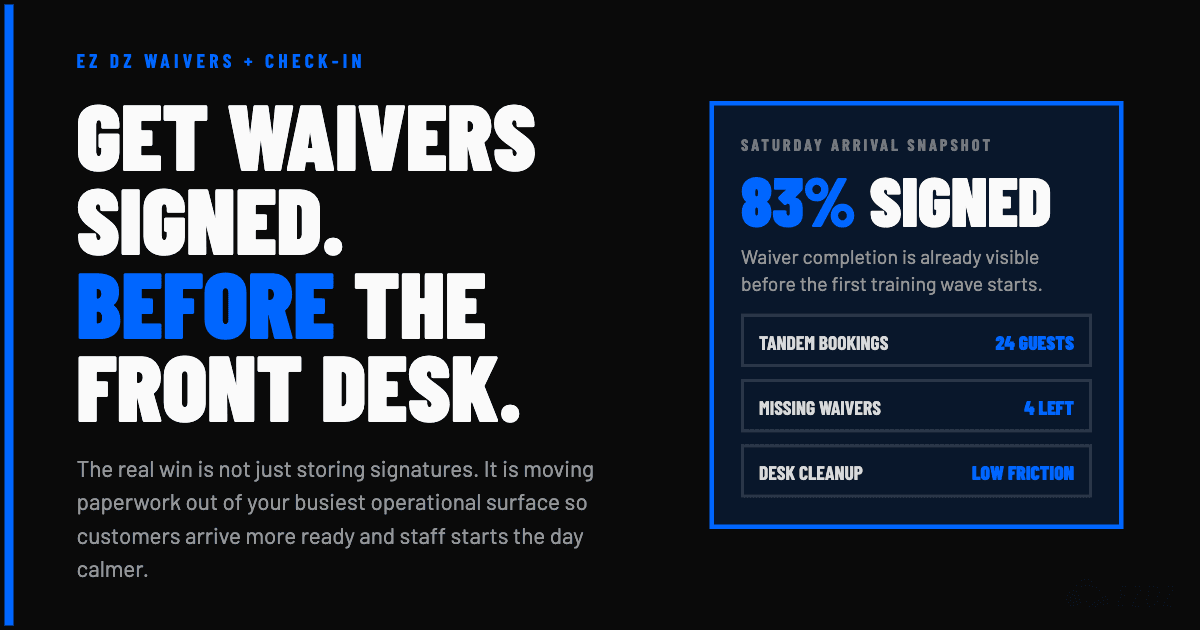
If tandem customers are still signing waivers at your front desk, you are using your busiest operational surface to solve a problem that should have been handled earlier. The fix is not complicated: pre-send the waiver at booking, remind at the right moment, make completion status visible at check-in, and keep annual renewal logic clean for repeat jumpers too. That one system change reduces line friction, protects first-load timing, and makes the whole day feel calmer.
Here is a question I think most DZOs already know the answer to, even if nobody says it out loud: why are we still using the front desk to finish paperwork that could have been handled the night before?
When a tandem customer shows up excited, late, under-caffeinated, or managing three friends in the same car, the counter is the worst possible place to ask for careful form completion. Staff is already juggling arrivals, payments, gear questions, late bookings, phone calls, and whatever surprise the weather decided to add that morning. That is not a paperwork environment. It is a pressure environment.
I learned a version of this in real estate and then again in the moving-box business: if a step can be completed before the customer hits your highest-friction moment, move it upstream. Do not wait until the system is busy and then hope human effort makes the process feel smooth. It almost never does.
The hidden cost of front-desk waivers
Most owners think incomplete waivers are a minor annoyance. I do not think that is right. They are a throughput problem hiding inside an admin task. If six tandem customers on a busy Saturday arrive without a signed waiver, and each one takes just four extra minutes of counter time between explanations, phone handoff, signature errors, and staff verification, that is 24 minutes of direct desk drag. Add the interruptions they create for everyone behind them and the real operational cost is higher.
Now zoom out a little. That same friction rarely stays contained at check-in. It pushes training later, creates avoidable tension around first-load timing, and forces manifest to work around readiness uncertainty that should not exist in the first place. If the day starts behind, the rest of the board usually pays for it.
This is why I do not think of digital waiver software as a legal-storage tool first. I think of it as an operational speed tool. Yes, it gives you signed records and audit trails. But the real day-to-day win is simpler: customers arrive more ready, staff asks fewer basic questions, and manifest can see readiness earlier instead of discovering missing paperwork when the line is already forming.
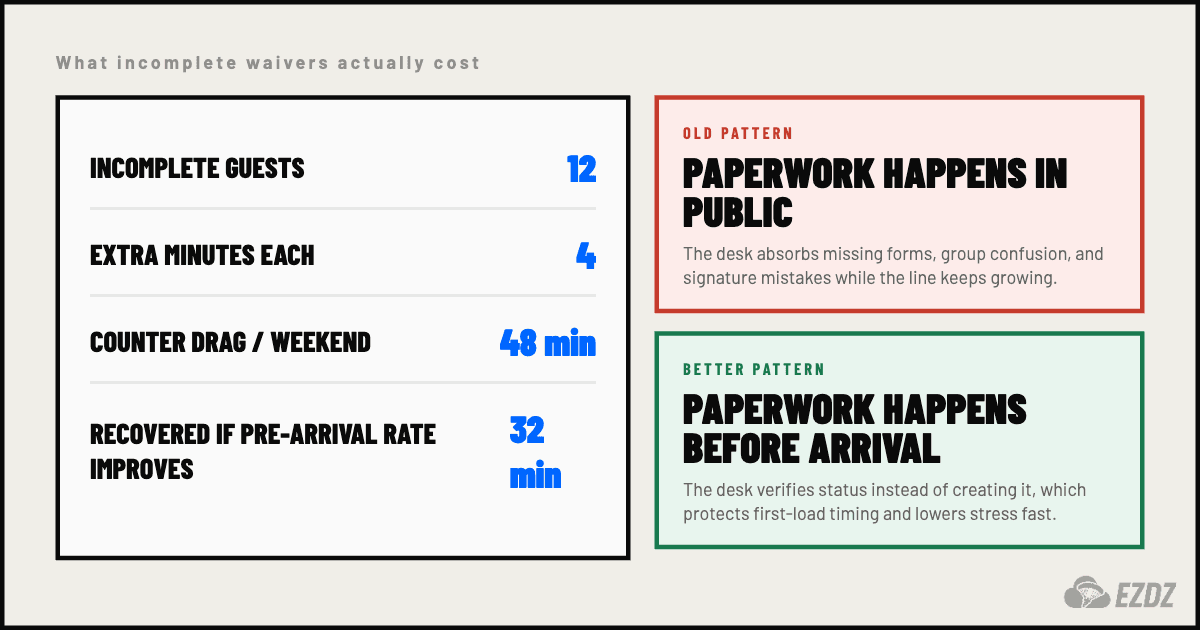
The goal is not just to collect signatures. The goal is to move waiver completion out of your busiest operating surface and into a calmer moment where customers are more likely to finish it correctly.
Why the manual approach keeps breaking
The usual fallback sounds reasonable on paper: send a confirmation email, hope they read it, mention the waiver again when they arrive, and let the desk clean up what is left. The problem is that this is not a real system. It is a vague intention with a cleanup crew attached to it.
Customers do not ignore waivers because they are malicious. They ignore them because the timing is wrong, the link gets buried, the importance is not clear yet, or the booking buyer assumes everyone else in the group handled their part. Human behavior matters here. A waiver request sent at the wrong moment becomes invisible. A reminder sent at the right moment feels helpful.
- **The ask is too soft:** The waiver is mentioned, but not presented as the next required action after booking.
- **The timing is lazy:** There is no follow-up tied to when people are actually thinking about tomorrow's jump.
- **The desk has no clean visibility:** Staff still has to ask who is complete and who is not, which defeats half the point.
- **Repeat-customer logic is messy:** Fun jumpers and tandem guests get mixed into a workflow that should be cleanly segmented.
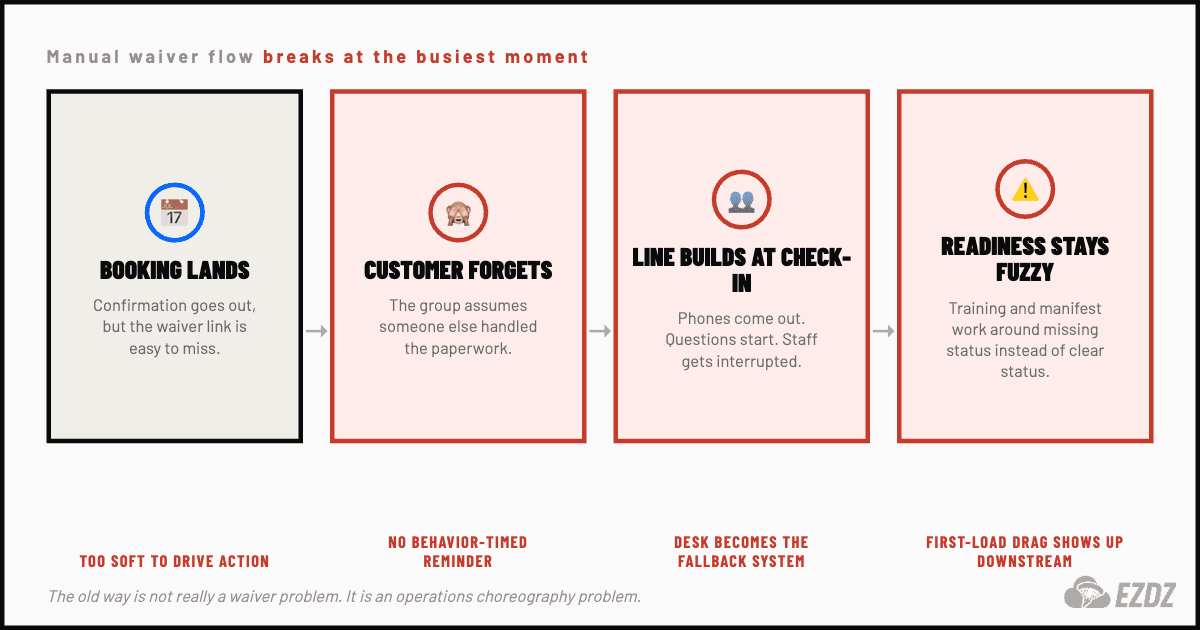
In startup land, people like to talk about optimization. I usually care more about choreography. The right steps in the wrong order still create a bad customer experience. Waivers are a choreography problem.
The pre-arrival waiver system that actually works
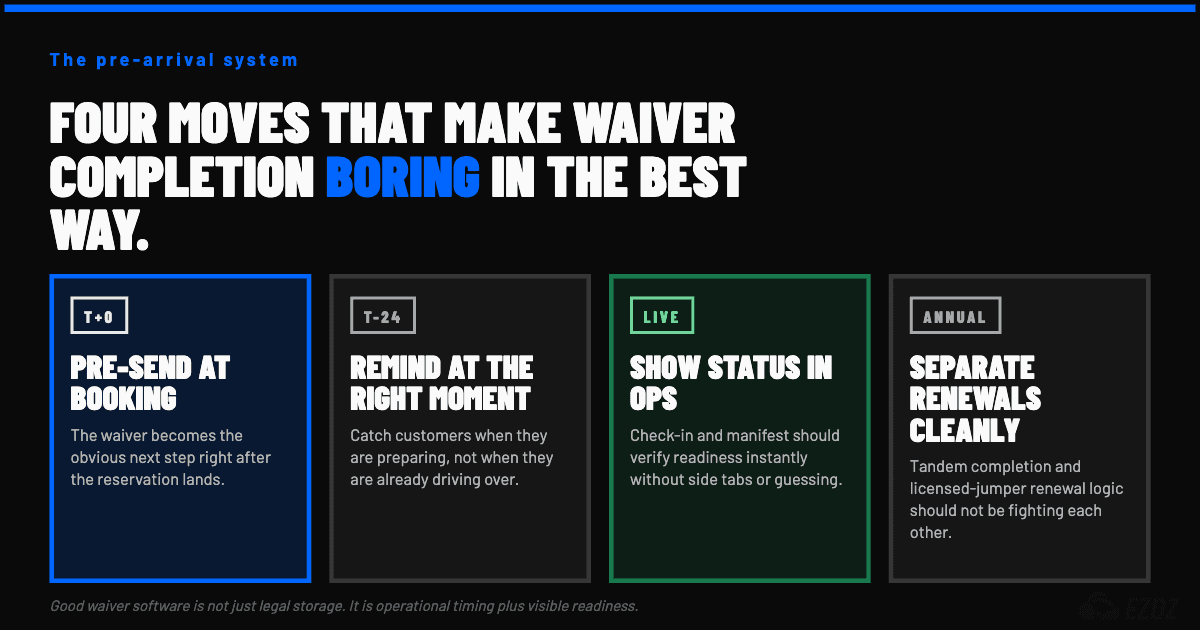
The best version of this workflow is boring, which is exactly what you want. Nothing dramatic happens at the desk because most of the real work already happened upstream. For dropzones, I think the system has four pieces.
1. Make the waiver the immediate next step after booking
When someone books a tandem, the waiver link should not feel optional or buried. It should feel like part two of the booking process. That means the confirmation flow should point clearly to it, the language should explain that it saves time on arrival, and the experience should be mobile-friendly because that is where a lot of these completions happen. If the customer has to hunt for the next step, your completion rate drops before the day even starts.
2. Remind at the moment customers are mentally preparing
I like reminder timing that matches behavior, not staff convenience. For next-day tandems, a reminder around 9am the day before works well because customers are usually still planning tomorrow, checking texts, and not yet buried in the evening. For closer-in bookings, the important thing is the same principle: hit them when they still have time to act, not when they are already walking out the door.
3. Show completion status where the operation actually needs it
A signed waiver only helps operations if the status is visible without detective work. Check-in and manifest should be able to see who is complete immediately. This is where integration matters. If waiver status lives in a separate tab, separate inbox, or someone's memory, you have not really solved the problem. You just digitized the paperwork.
4. Separate tandem completion from annual renewal logic
Tandem customers and licensed jumpers create different waiver problems. Tandems need simple pre-arrival completion. Fun jumpers need clear renewal windows, expiration visibility, and reminders before an annual waiver becomes a load-day issue. Keeping those tracks clean reduces edge-case confusion and helps staff make faster decisions when the board gets tight.
Learn more about EZDZ built-in skydiving waivers and manifest workflows to see how live readiness visibility helps staff move faster when waiver status, payments, and customer records stay in sync.
What the weekend math looks like
Let us use a grounded example. Say your dropzone books 40 tandem customers over a weekend. If 30% would normally arrive with an incomplete waiver, that is 12 people. If each one steals just four minutes of staff time, that is 48 minutes of extra counter friction. If a better pre-arrival system cuts that incomplete rate from 30% to 10%, you just got back 32 minutes of operational capacity on a single weekend.
And that is still the conservative version, because the real value is not only time recovered. Cleaner waiver completion means fewer bottlenecks during check-in, less first-load drag, fewer rushed conversations, and a better customer first impression. Over a 30-week season, reclaiming even 30 minutes of frontline capacity each weekend adds up to 15 hours of less chaos at one of the most expensive moments to be chaotic.
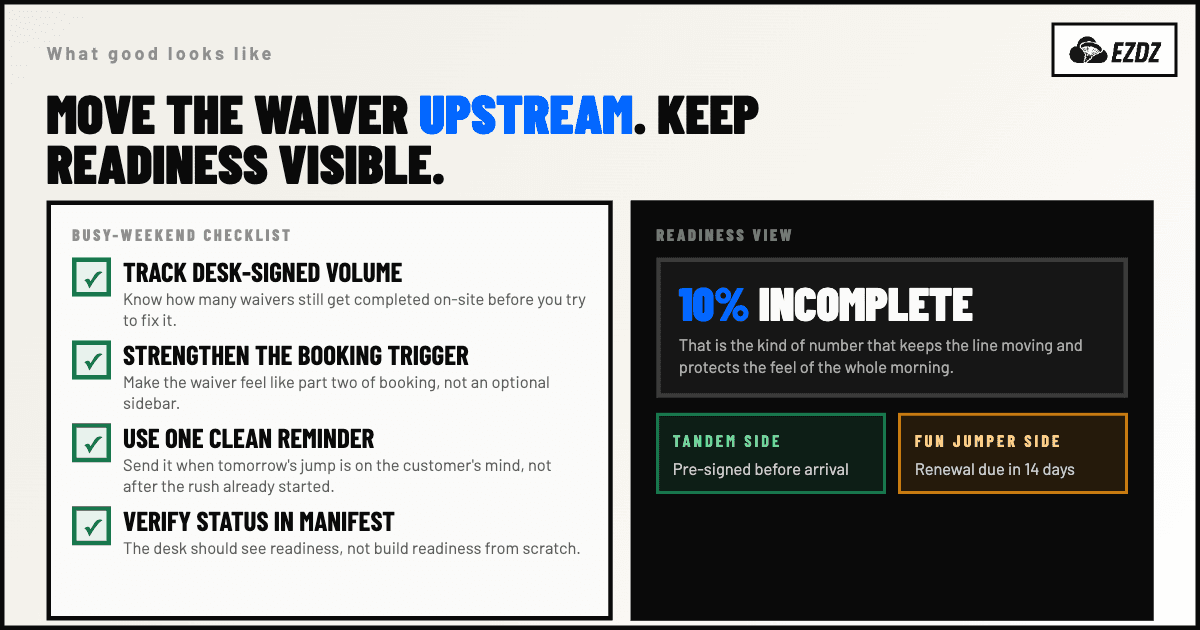
- **Measure the current leak:** Track how many tandem customers still sign at the desk today.
- **Put a minute value on it:** Estimate the true time cost, including interruptions and re-checks.
- **Improve the trigger and reminder:** Make waiver completion part of the booking follow-up, not a vague afterthought.
- **Verify the visibility layer:** Staff should know status instantly without opening side tools or asking extra questions.
Small operational gains compound hard in skydiving. You do not need to save an hour a day for this to matter. Saving a few minutes at the exact moment your whole front-end system is under pressure is worth far more than the same minutes saved somewhere easy.
Where to start this week
If your current process still depends on clipboards or last-minute texting, do not start by trying to automate everything at once. First, make waiver completion measurable. Then make the booking confirmation point clearly to the waiver as the next step. Then add the reminder timing. Then make the status visible to the desk and manifest. Sequence matters.
EZ DZ handles this well because the broader philosophy is the same across the platform: solve readiness upstream, keep operational visibility live, and stop asking staff to do cleanup work that software could have prevented. If you are already using EZ DZ, your waiver flow should be part of that system. If you are not, the principle still stands. Get this out of the front desk as fast as you can.
Ready to get more waivers signed before customers arrive?
The best check-in lines are the ones that never had to solve basic paperwork in public. When waiver completion happens upstream, the whole day starts cleaner.
Get started and see how EZ DZ keeps booking follow-up, waiver completion, and manifest visibility working together, or reach out if you want to talk through how your current waiver workflow breaks down on busy weekends. Even if you solve it another way, solve it. This is one of those small operational systems that changes the feel of the whole day.